
General Dentist in Frederick, MD

General Dentistry Offers an Array of Services to Help Maintain Your Glowing Smile
When you are searching for quality dental health care for your entire family, this is where your general dentist in Frederick, MD comes in. A general dentist is available as the primary dental care provider for patients of all ages, which is crucial to your total health. Your Frederick, MD dentist takes responsibility for the diagnosis, treatment and overall coordination of services to meet your oral health needs.
When visiting your general dentist, if you need a specialized dental procedure performed, they will work with other dentists to make sure you get the care you need and deserve in order to continue to smile for a lifetime. Making up the majority of the 143,000 dentists that are currently practicing in the United States and Canada, general dentists sometimes become partners or associates with other dentists in a group practice, while others own their own practice.
General Dental Services
Your general dentist in Frederick, MD is highly educated and trained on all dental procedures. Instead of just specializing in one phase of dentistry, she can provide an array of different dental services for you and your entire family, including:
- Cosmetic procedures
- Crowns and bridges
- Dental implants
- Dentures
- Gum disease treatment
- Home care instructions
- Orthodontics
- Restorative care
- Root canal therapy
- Teeth cleanings
Dental Cleanings and Checkups
At your regular dental visit, your Frederick dentist will check your teeth for tooth decay. Your dentist will also evaluate the health of your gums, perform a head and neck examination and examine your mouth for any indications of oral cancer, diabetes or vitamin deficiencies. Don’t be alarmed if your dentist also examines your face, bite, saliva and movement of your lower jaw joints. Your dentist or dental hygienist will then clean your teeth and stress the importance of you maintaining good oral hygiene at home between visits.
During the cleaning portion of your exam, your dentist will complete the following:
- Checking the cleanliness of your teeth and gums
- Removing any plaque and tartar
- Polishing your teeth
- Flossing between your teeth
- Reviewing recommended brushing and flossing techniques
Bridges
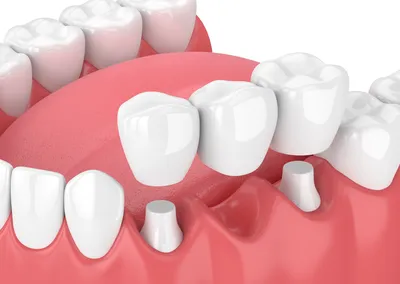
A bridge is a restoration that makes your smile complete again after tooth loss. Bridges use prosthetic teeth to “bridge” the gaps caused by missing teeth. These prosthetic teeth are crafted from metal, porcelain, or porcelain fused to metal, and are matched in size, shape, and color to the teeth they’re replacing for a natural appearance. A bridge can replace up to four adjacent teeth but is typically used to replace one or two.
Traditional bridges are fixed in place and are anchored by crowns placed on the healthy teeth on each side of the gap. Bridges can also be attached to dental implants. Because a bridge requires healthy teeth, gums, and bone for a long-lasting and successful restoration, any dental problems will need to be treated beforehand.
Crowns
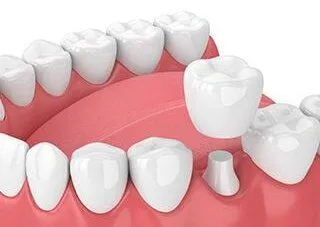
When a tooth has suffered structural or cosmetic damage, a dental crown can restore a tooth’s function and appearance. A crown is a custom-made “cap” which covers the entire visible surface of the tooth. Crowns are used to strengthen and protect teeth with extensive decay, breakage, or cracks, restore a tooth after a root canal procedure, cover a discolored or irregularly shaped tooth, serve as an anchor for a dental bridge, or complete a dental implant procedure.
Most crown placements require two appointments: one appointment to prepare the tooth and take an impression for crown fabrication, and one visit to fit and bond the crown to the prepared tooth. Crowns are available in several different materials. You can choose metal, porcelain, or composite resin based on factors such as durability, natural appearance, and cost.
Dentures
If you’ve lost some or all of your teeth because of trauma, periodontal infection, or decay, dentures are one option which can offer you a healthier, more attractive smile. Full or partial dentures make it easier to eat, chew, and speak clearly, support the cheeks and lips for a more youthful appearance, prevent remaining teeth from shifting out of place, and restore self-confidence.
Conventional full dentures are created and placed after the gums have healed following any extractions. Immediate dentures are placed directly after extraction, and typically require regular adjustments for fit and comfort. Partial dentures are secured to adjacent teeth, and, unlike bridges, are removable. Implant-supported full and partial dentures are also an option.
Fillings
When decay is caught early, your Frederick, MD dentist can treat your cavity conservatively by restoring your tooth’s function and appearance with a filling.
For most small to moderate cavities, direct fillings can be bonded to the tooth immediately after removing decay and cleaning and shaping the tooth. Composite resin, dental amalgam, and glass ionomer fillings are typically used for this type of single visit restoration.
An indirect filling restores molars and premolars with larger areas of damage or decay. An inlay fills the tooth surface inside the cusps, while an onlay typically covers the center of the tooth and one or more cusps. Indirect fillings can be made of composite resin, gold, or porcelain, and are created from a mold taken after the tooth is cleaned and prepped. The finished filling is bonded to the tooth at a second visit.
Implant Dentistry
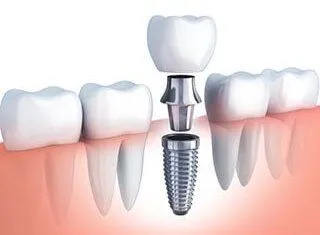
Dental implants from your dentist in Frederick, MD are a popular and effective way to replace lost teeth. During the implant procedure, a cylinder or screw, usually made of titanium, is surgically implanted into the jawbone. The implant fuses with the bone over several months. Once the area has healed, an abutment is connected on one end to the inside of the implant. A crown is then securely attached to the other end of the abutment, which sits above the gum line. The result is a tooth which looks and functions just like a natural tooth.
Candidates for implants need healthy bone for the implant to succeed. If there are concerns with bone size or density, a bone graft can be performed first. After three to four months of healing, the jawbone generally has enough size and density to accept an implant.
Root Canal Treatment
When bacteria infect the tooth pulp, a root canal procedure is necessary. Root canal treatment prevents more widespread infection by removing infected pulp tissue and saves your natural tooth by restoring tooth strength and structure with a crown.
Root canal procedures are straightforward. After the area around the tooth is numbed, your Frederick, MD dentist will make an opening in the crown to allow access to the pulp inside. Delicate dental instruments will be used to clean the inner tooth and removed bacteria and dead or dying tissue. The area will be thoroughly disinfected, and the inside of the tooth shaped, filled, and sealed.
A temporary filling or crown might be placed on the tooth to prevent bacteria and food from entering the site while a permanent crown is created. The entire process usually takes from one to three visits.
Tooth Extractions

Dentists strive to save teeth, but sometimes extraction is necessary. Teeth might be too damaged to save due to trauma, infection, deep decay, or gum disease. Baby teeth which don’t fall out, wisdom teeth which pressure adjacent teeth, or severely overcrowded teeth might also be best treated with extraction.
Teeth are held in place by periodontal ligaments attached to the tooth socket. After the area is numbed, your dentist will use special tools to carefully loosen the tooth and lift it from the socket. A bone graft might be placed in the socket to protect your bone density before closing the site.
You’ll be given instructions to protect the site from infection and from a painful condition called dry socket. To prevent complications such as bone loss or shifting teeth caused by a missing tooth, you should discuss tooth replacement with your Frederick dentist.